
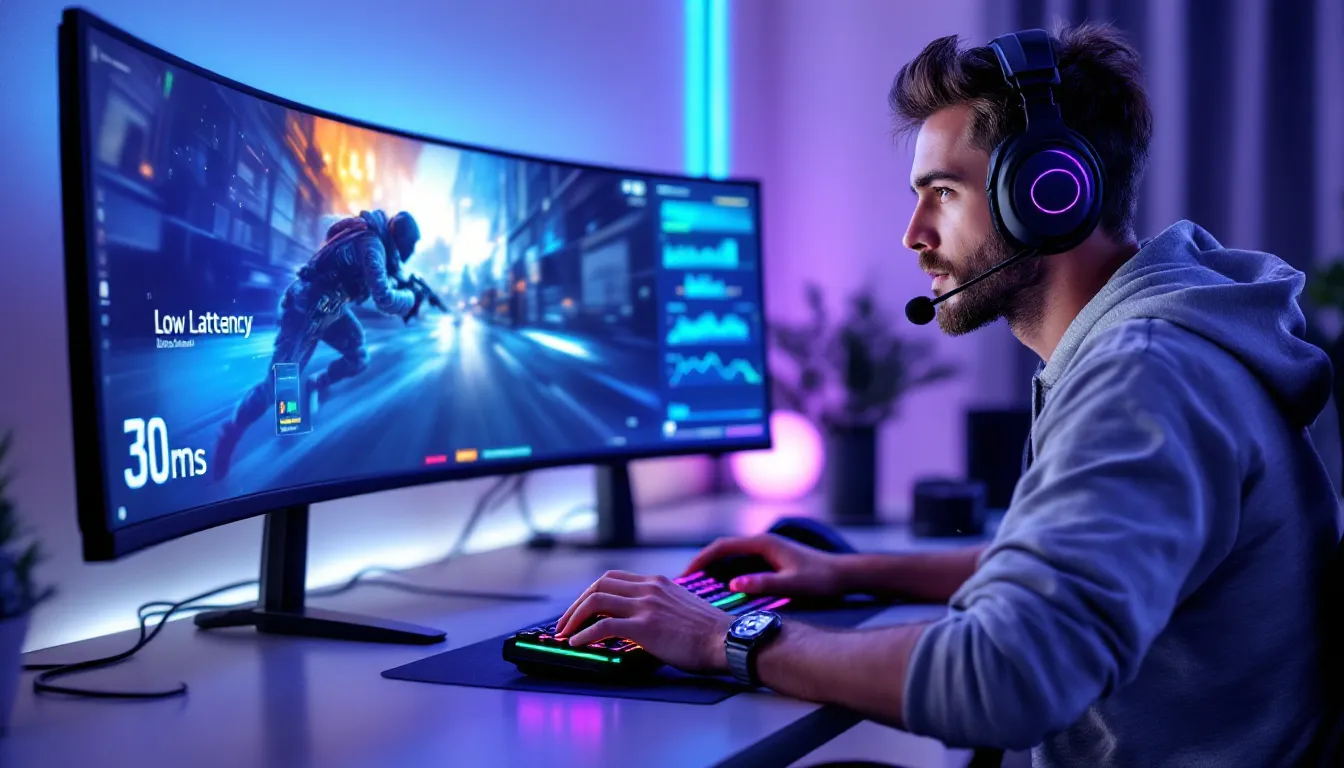
Latency can make the difference between landing that perfect headshot and watching your character die before you even register the threat. In 2026, with competitive gaming more demanding than ever and player skill ceilings constantly rising, understanding what constitutes good latency isn’t just helpful, it’s essential. Whether you’re grinding ranked in Valorant, competing in Street Fighter 6 tournaments, or just trying to enjoy a smooth session of Final Fantasy XIV, your connection quality directly impacts your ability to play at your best.
This guide breaks down everything you need to know about gaming latency: what the numbers actually mean, how different game genres demand different standards, and what you can realistically achieve based on your setup and location. No fluff, no corporate buzzwords, just the concrete benchmarks and practical knowledge you need to optimize your gaming experience.
Key Takeaways
- Good latency for gaming typically ranges from 20-50ms for competitive play, with under 30ms preferred for twitch-based shooters and fighting games.
- Different game genres have different latency requirements—competitive shooters demand sub-40ms, while MMORPGs and turn-based strategy games tolerate 100-200ms comfortably.
- Switching to a wired ethernet connection is the single biggest improvement you can make, reducing latency by 10-40ms compared to Wi-Fi.
- Your physical distance to the game server creates a hard latency floor—each 100km adds roughly 1ms of delay, making server location selection critical.
- Network latency matters more than raw frame rate for competitive gaming; a stable 40ms connection at 144 FPS beats an 80ms connection at 360 FPS.
Understanding Latency and Why It Matters for Gamers
Before diving into specific numbers, it’s crucial to understand what latency actually is and why it affects your gameplay. Many players use terms like ping, lag, and latency interchangeably, but they’re not quite the same thing.
The Difference Between Latency, Ping, and Lag
Latency is the time it takes for data to travel from your device to the game server and back, measured in milliseconds (ms). It’s the raw measurement of your connection’s responsiveness.
Ping is essentially the same thing as latency in gaming contexts, it’s the tool used to measure latency, and the terms are functionally identical. When you see “45ms ping” in your game’s scoreboard, that’s your current latency to that server.
Lag, on the other hand, is the noticeable effect of high latency or poor connection quality. It’s the symptom, not the measurement. You experience lag when latency gets high enough that it disrupts gameplay, characters teleporting, delayed inputs, or rubber-banding movement.
Think of it this way: latency is your speedometer reading, ping is how you check that reading, and lag is what happens when you’re going too slow.
How Latency Affects Your Gaming Experience
Every action you take in an online game requires a round trip to the server. When you press the fire button, that input travels to the server, the server processes it and updates the game state, then sends that information back to you and all other players. This entire cycle takes time, that’s your latency.
At 20ms, this round trip is nearly imperceptible. Your shots register almost instantly, and the game feels responsive and tight. At 100ms, there’s a noticeable delay between action and result. In fast-paced games, that tenth of a second can mean you’re already dead before your opponent even appears on your screen.
Latency doesn’t just affect combat. It impacts movement precision, ability timing, trading in MMORPGs, and even your perception of game feel. A game running at 240 FPS with 150ms latency will feel worse than the same game at 60 FPS with 20ms latency, the input delay is just too significant.
What Latency Numbers Mean: Breaking Down the Benchmarks
Raw numbers don’t mean much without context. Here’s what different latency ranges actually feel like in practice and what you can expect at each tier.
Excellent Latency (Under 20ms)
This is the gold standard for competitive gaming. Under 20ms, input delay is virtually non-existent, and you’re playing with the absolute minimum handicap from your connection. You’ll typically only achieve this if you’re geographically close to the server or have exceptional infrastructure.
At this level, peekers advantage is maximized, your shots register instantly, and movement feels perfectly responsive. Many pro players competing in official tournaments specifically seek out servers in this range and will dodge lobbies with higher ping.
Realistically, most players won’t maintain sub-20ms consistently unless they live in major metropolitan areas with fiber connections and play on nearby servers.
Good Latency (20-50ms)
This is the sweet spot for most gamers. Between 20-50ms, the game still feels highly responsive, and you won’t be at any meaningful disadvantage in competitive play. The difference between 25ms and 45ms is measurable but rarely noticeable in actual gameplay.
At this range, you can compete at high ranks, stream without connection issues, and enjoy fast-paced shooters without feeling like your connection is holding you back. This is what most players on quality home internet should target as their standard.
If you’re consistently getting 30-40ms to your preferred game servers, you’re in great shape and shouldn’t worry about connection quality being a limiting factor.
Acceptable Latency (50-100ms)
Once you cross 50ms, you start entering acceptable-but-not-ideal territory. Games remain playable, but you’ll notice the delay in twitch-based scenarios. Peeking corners becomes riskier, trading kills happens less favorably, and timing-based abilities require more prediction.
For slower-paced games, this range is perfectly fine. MMORPGs, turn-based strategy games, and casual shooters all function well here. But if you’re trying to climb ranked in Valorant or hit Diamond in Apex Legends, 80ms puts you at a disadvantage against opponents with better connections.
Many players in regions far from server clusters operate in this range permanently. It’s playable, but optimization becomes more important.
Poor Latency (Above 100ms)
Once latency exceeds 100ms, you’re dealing with noticeable input delay that actively interferes with gameplay. Fast-paced competitive games become frustrating exercises in prediction and adaptation rather than reflex and precision.
Above 150ms, even casual gaming becomes problematic. You’ll experience rubber-banding, delayed ability casts, and situations where you’re shot behind cover. At 200ms+, most online games are borderline unplayable for anything beyond turn-based experiences.
If you’re consistently above 100ms, the issue is likely your ISP, server location, or network configuration, all fixable problems we’ll address later.
Ideal Latency Standards by Game Type
Not all games demand the same connection quality. A turn-based RPG can function fine at 150ms, while a fighting game becomes unplayable above 50ms. Here’s what you should target based on genre.
Competitive Shooters and FPS Games
For titles like Valorant, Counter-Strike 2, Call of Duty, and Rainbow Six Siege, you want to be under 40ms at minimum for serious ranked play. Professional and high-elo players typically won’t tolerate anything above 30ms.
These games have extremely low TTK (time-to-kill) and reward precise aim and fast reactions. At 60ms, you’re seeing enemies roughly 60 milliseconds later than someone at 20ms, enough time for them to land a headshot first in a mirror matchup.
Target benchmark: Under 30ms for competitive, under 50ms for casual play.
MOBA and Battle Royale Games
League of Legends, Dota 2, Apex Legends, and Fortnite are slightly more forgiving than pure shooters, but latency still matters significantly. Ability combos, skillshot accuracy, and movement prediction all suffer with higher ping.
Most MOBA players can compete reasonably well up to 60ms, though you’ll notice the difference in high-level play. Battle royales vary, Fortnite’s building mechanics demand low latency, while PUBG’s slower pace is more forgiving.
Target benchmark: 30-50ms for optimal performance, up to 70ms remains competitive.
Fighting Games and Rhythm Games
These genres are brutally unforgiving of latency. Fighting games like Street Fighter 6, Tekken 8, and Guilty Gear Strive use rollback netcode to compensate, but physics-defying rollback corrections still occur above 50ms.
Rhythm games like Beat Saber or mobile titles demand near-perfect sync between input and audio/visual feedback. Even 40-50ms can throw off your timing enough to miss notes.
Target benchmark: Under 50ms absolute maximum, under 30ms preferred.
MMORPGs and Strategy Games
Final Fantasy XIV, World of Warcraft, Civilization VI, and similar games are far more latency-tolerant. You can raid in FFXIV at 100ms without major issues, though double-weaving abilities becomes trickier.
Strategy games can function perfectly fine at 150ms+ since they’re not reflex-based. The main concern is stability rather than raw speed.
Target benchmark: Under 100ms for MMORPGs, under 200ms for turn-based strategy.
Single-Player and Casual Games
For single-player experiences or casual co-op games, latency standards relax significantly. Games like It Takes Two, Stardew Valley, or Minecraft function fine even at 150ms since precision timing isn’t critical.
Target benchmark: Under 150ms for smooth co-op experiences.
Platform-Specific Latency Considerations
Your gaming platform introduces its own latency variables beyond just your internet connection. Understanding platform-specific factors helps set realistic expectations.
PC Gaming Latency Expectations
PC offers the best potential for low latency gaming. Wired ethernet connections, optimized network stacks, and direct server connections minimize overhead. Most competitive PC players achieve 20-40ms to regional servers with quality internet.
PC also offers the most control, you can optimize router settings, use gaming NICs, prioritize network traffic, and choose between multiple launchers and server browsers. Tools like ping displays and server selection are standard features.
The tradeoff is complexity. PC gamers need to maintain their network setup, update drivers, and troubleshoot issues themselves. But the ceiling for performance is highest here.
Console Gaming Latency Standards
PS5 and Xbox Series X
|
S have improved network performance over previous generations, but they still introduce slightly more latency than equivalent PC setups. Console OS overhead, matchmaking systems, and platform-specific networking add 5-10ms on average.
Consoles also limit your control over network settings. You’re generally stuck with whatever matchmaking gives you, and server selection is often automatic. Wired connections are still essential for competitive play.
Modern consoles support ethernet and have decent Wi-Fi 6 implementations, but many casual players use Wi-Fi by default, adding significant latency variance. If you’re serious about competitive console gaming, ethernet is non-negotiable.
Mobile Gaming Latency Challenges
Mobile gaming faces the toughest latency challenges. Even flagship devices like the iPhone 15 Pro struggle with consistent low latency due to reliance on Wi-Fi or cellular connections.
Wi-Fi adds 10-30ms of latency overhead compared to wired connections, and cellular can spike to 100ms+ depending on signal quality and network congestion. Mobile games are designed around these limitations with more forgiving netcode and less twitchy gameplay.
For serious mobile gaming, you want Wi-Fi 6 or better, minimal distance to your router, and servers nearby. Don’t expect sub-30ms consistently on mobile, hitting 40-60ms is solid performance.
Factors That Impact Your Gaming Latency
Understanding what influences your ping helps you identify where improvements are possible. Some factors you can control, others you can’t.
Internet Connection Type and Speed
Your ISP and connection type are the foundation. Fiber optic connections offer the lowest latency, typically 5-15ms to your ISP’s first hop. Cable internet is next at 15-30ms, while DSL ranges from 25-50ms. Satellite internet is the worst for gaming, often exceeding 500ms due to signal travel distance.
Bandwidth (download/upload speed) matters less than you’d think. A stable 25 Mbps connection with low latency beats an unstable 1 Gbps connection with ping spikes. What matters is consistent, low-latency routing.
Jitter, variation in latency, is often more disruptive than slightly higher stable ping. A connection that bounces between 30ms and 90ms feels worse than one stable at 50ms.
Server Location and Distance
Physics imposes hard limits on latency. Data travels through fiber optic cables at roughly 2/3 the speed of light, meaning each 100km of distance adds approximately 1ms of latency (round trip).
If you’re in New York connecting to a California server 4,000km away, you’re looking at a minimum of 40ms just from physical distance, before accounting for routing inefficiencies. Connecting to European servers from the US? Expect 80-120ms minimum.
This is why major games deploy servers in multiple regions. Always select the geographically closest server when possible.
Network Congestion and Peak Hours
Your latency isn’t constant throughout the day. During peak usage hours (typically 6-11 PM local time), ISP networks experience congestion that increases latency and packet loss.
You might see 30ms at 2 PM and 65ms at 8 PM on the same connection. This is especially noticeable on cable internet where you share bandwidth with your neighborhood.
Some ISPs carry out QoS systems that deprioritize gaming traffic during congestion, further degrading performance. Gaming VPNs can sometimes route around congested peering points, though they add their own overhead.
Hardware and Router Performance
Your router processes every packet, and cheap or outdated routers introduce latency through processing overhead. A budget router might add 5-15ms compared to a quality gaming router with optimized firmware.
Routers with bufferbloat issues, excessive packet buffering, cause latency spikes under load. If your ping jumps when someone else streams Netflix, that’s bufferbloat.
Your network card, motherboard, and even CPU can influence latency. Modern hardware introduces minimal overhead, but very old systems might add measurable delay.
How to Test Your Gaming Latency Accurately
Generic speed tests don’t tell the whole story for gaming. You need to test latency specifically to game servers, not just the nearest speed test node.
In-Game Ping Displays
Most modern games show your current ping in the scoreboard or settings menu. This is your most accurate measurement since it reflects actual latency to the game server you’re playing on.
In Valorant, Apex Legends, and most shooters, ping displays update in real-time. Watch for spikes and variance, not just the average number. A ping that bounces between 30ms and 80ms indicates an unstable connection.
Some games hide ping by default. Check your HUD settings to enable network statistics, most competitive games offer detailed network overlays.
Third-Party Speed Test Tools
Services like Speedtest.net or Fast.com measure latency to their servers, which gives you a baseline but doesn’t reflect gaming performance. Use these to check overall connection health, not game-specific latency.
For more relevant testing, resources like RTINGS provide methodologies for measuring total system latency including display lag, which factors into perceived responsiveness.
PingPlotter is excellent for diagnosing where latency issues occur in your routing path. It traces each hop from your PC to the destination, showing which router along the path introduces delay.
Server-Specific Ping Commands
For technical users, command-line ping tests to specific game server IPs provide precise measurements. In Windows, open Command Prompt and type ping [server IP] -t for continuous testing.
Many games publish their server IP addresses. You can ping these before launching the game to check if your connection is optimal. If you’re seeing 25ms in ping tests but 65ms in-game, the game’s netcode or server load is adding overhead.
Console users have fewer testing options but can usually check connection statistics in system settings for baseline measurements.
Proven Ways to Improve Your Gaming Latency
If your latency isn’t where you want it, several optimization strategies can bring measurable improvements.
Switch to a Wired Ethernet Connection
This is the single biggest improvement most gamers can make. Wi-Fi inherently adds 10-40ms of latency compared to ethernet, plus introduces jitter and packet loss.
Even Wi-Fi 6 on a flagship router can’t match the stability of a Cat 6 ethernet cable. Wireless protocols require acknowledgment packets, retry logic, and channel negotiation, all adding delay.
If running cable isn’t possible, powerline adapters offer a middle ground. They’re not as good as direct ethernet but significantly better than Wi-Fi for gaming.
Optimize Your Router Settings and Placement
Enable QoS (Quality of Service) settings to prioritize gaming traffic. Most modern routers let you assign priority to specific devices or applications, ensuring your gaming packets get processed first during congestion.
Place your router centrally and elevated, away from metal objects and other electronics that cause interference. If you must use Wi-Fi, 5GHz bands offer lower latency than 2.4GHz even though shorter range.
Update your router firmware regularly. Manufacturers often release updates that improve routing efficiency and fix bufferbloat issues.
Close Bandwidth-Heavy Applications
Background downloads, streaming, cloud backups, and browser tabs all compete for bandwidth and processing priority. Windows Update running mid-game can spike your ping by 50ms+.
Close Discord streams, pause Steam downloads, and disable automatic cloud sync during competitive sessions. Every background process using your connection adds potential latency.
On PC, use Task Manager to identify network-heavy processes. On console, suspend downloads before starting online matches.
Choose Servers Closest to Your Location
Always manually select the lowest-ping server when games offer the option. Auto-matchmaking often prioritizes connection speed over latency, throwing you into distant servers unnecessarily.
In games with server browsers, sort by ping and avoid anything over 60ms unless player population demands it. Playing on the right server matters more than most settings tweaks combined.
Some players even use gaming VPNs to route around poor ISP peering, though this is advanced optimization that doesn’t help everyone.
Upgrade Your Internet Plan or Hardware
If you’ve exhausted software optimizations, hardware upgrades might be necessary. Upgrading from DSL to fiber can cut latency in half. Replacing a 10-year-old router eliminates processing overhead.
Contact your ISP if you consistently experience high latency. Sometimes they can adjust routing or identify line issues. Business-tier internet plans often include better routing and priority support.
For competitive players, gaming routers with optimized firmware and bufferbloat mitigation justify their cost through consistent performance.
Latency vs. Frame Rate: What Should You Prioritize?
Players often debate whether high FPS or low latency matters more. The answer depends on context, but generally: you need both.
Frame rate affects how smoothly the game displays and how quickly you can see and react to changes. Higher FPS reduces input lag from your mouse/controller to the screen. Going from 60 FPS to 240 FPS cuts display latency by roughly 10ms.
Network latency affects how quickly your actions register on the server and how current the information you’re seeing is. Low latency means the game state you’re viewing matches reality more closely.
Here’s the thing: frame rate improvements hit diminishing returns past 144 FPS for most players. The jump from 60 to 144 is massive: from 144 to 240 is noticeable but smaller. Network latency improvements are linear, cutting ping from 60ms to 30ms always provides the same 30ms advantage.
For competitive play, prioritize latency first. A stable 40ms connection at 144 FPS beats a 80ms connection at 360 FPS. Once you’re under 40ms, then maximize frame rate. On mobile platforms where both frame rate and latency face more constraints, the balance shifts toward optimizing for the most stable connection possible.
Both matter, but you can’t aim your way out of a bad connection. Get your latency right first, then chase frames.
Conclusion
Good latency for gaming isn’t a single magic number, it’s a range that depends on what you’re playing, where you’re playing it, and how seriously you take competition. For most gamers, anything under 50ms provides an excellent experience, while competitive players should target sub-30ms for twitch-based games.
The beauty of optimizing latency is that unlike skill improvement, it’s mostly about fixing technical issues rather than grinding practice. Switching to ethernet, selecting the right servers, and upgrading outdated hardware can instantly cut your ping in half. Those improvements stick with you across every game and every session.
Don’t obsess over single-digit differences, someone with 25ms ping isn’t meaningfully advantaged over 35ms. But if you’re sitting at 100ms while competitors enjoy 30ms, that’s a fixable handicap worth addressing. Run the tests, make the changes, and get your connection out of the way so your actual skill can shine through.